
Medical Writing Explained: What It Is, Types, and Why Professionals Need It
January 14, 2026 | By Dr. Umair Abid, MBBS
About the Author
Dr. Umair Abid, MBBS, is a medical professional and content writer who helps businesses and professionals communicate ideas with clarity and impact. He specializes in transforming complex information into structured, persuasive content that informs and engages audiences.
Medical writing is no longer a niche skill limited to pharmaceutical companies or academic journals. In today’s digital-first healthcare ecosystem, high-quality medical writing is essential for credibility, compliance, visibility, and conversions. From research publications and regulatory documents to SEO-driven health blogs and patient education materials, medical writing sits at the intersection of science, communication, and trust.
This guide is designed to give you a clear, authoritative understanding of medical writing, who needs it, and why investing in professional medical writing is no longer optional, especially if accuracy, reputation, and results matter.
Table of Contents
ToggleWhat Is Medical Writing?
Medical writing is the practice of creating scientifically accurate, evidence-based, and audience-appropriate content related to medicine, healthcare, pharmaceuticals, and life sciences.
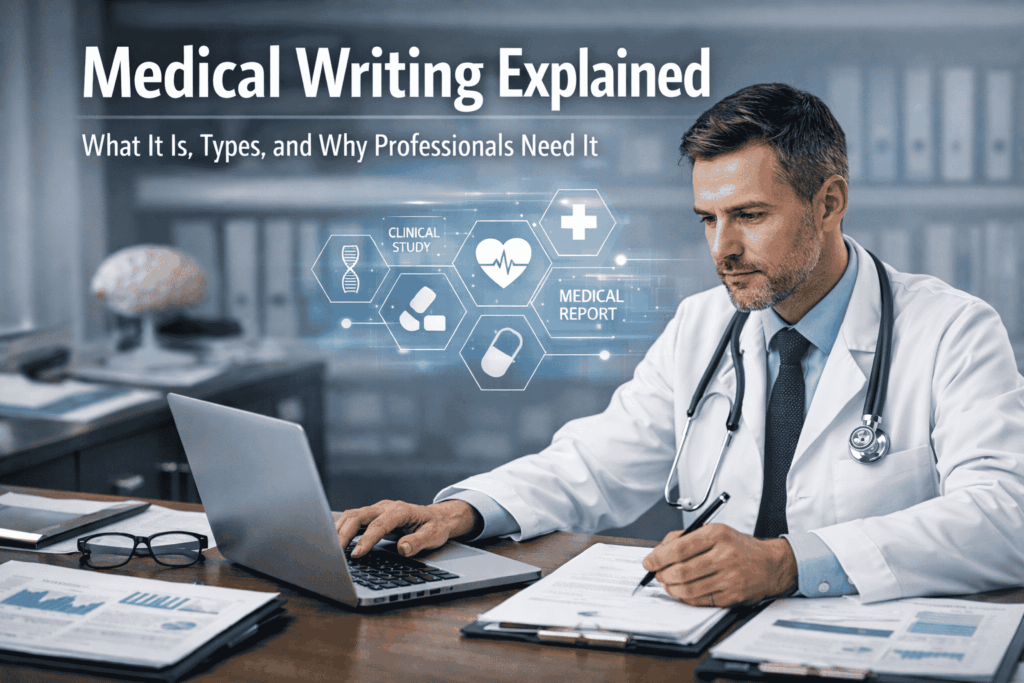
Unlike general content writing, medical writing requires:
- Deep subject-matter understanding
- Ability to interpret scientific data
- Strict adherence to ethical and regulatory standards
- Clear communication for diverse audiences (clinicians, regulators, patients, or the public)
At its core, medical writing transforms complex medical information into clear, credible, and usable content—without distortion, exaggeration, or misinformation.
Why Medical Writing Matters More Than Ever
Healthcare decisions are high-stakes. A poorly written medical document can:
- Damage professional credibility
- Lead to regulatory rejection
- Misinform patients
- Reduce search visibility
- Expose organizations to legal and ethical risk
Conversely, professionally written medical content builds trust, authority, and long-term value.
In an era of AI-generated content and misinformation, expert-led medical writing stands out.
Types of Medical Writing (With Real-World Applications)
Medical writing is a broad discipline. Below are the most important categories professionals should understand:

1. Regulatory Medical Writing
Used by pharmaceutical and biotech companies to meet regulatory requirements.
Examples:
- Clinical Study Reports (CSRs)
- Investigator Brochures
- Regulatory submissions (CTD, eCTD)
- Informed Consent Forms (ICFs)
Accuracy and compliance are non-negotiable here.
2. Scientific & Academic Writing
Focused on advancing medical knowledge and research dissemination.
Examples:
- Research papers
- Systematic reviews & meta-analyses
- Case reports
- Conference abstracts & posters
This type of writing demands strong research skills, referencing expertise, and journal-specific formatting.
3. Medical Education & Training Content
Used by institutions, educators, and healthcare platforms.
Examples:
- Lecture material
- CME modules
- Training manuals
- Medical textbooks
Clarity and structured explanation are key.
4. Medical Marketing & SEO Writing
This is where authority meets conversion.
Examples:
- Healthcare blog posts
- Website service pages
- Medical product explanations
- Evidence-based promotional content
The challenge: educate without misleading, persuade without exaggeration.
5. Patient Education & Public Health Content
Designed for non-medical audiences.
Examples:
- Patient leaflets
- Health awareness articles
- Hospital website content
- FAQs and explainer pages
Here, medical writing must be accurate and easy to understand.
Who Needs Professional Medical Writing?
Medical writing is not just for large pharmaceutical companies. Professionals who benefit include:
- Doctors & medical consultants
- Hospitals & clinics
- Pharma & biotech companies
- Healthcare startups
- Medical educators
- Health bloggers & digital platforms
- Research institutions
- NGOs & public health organizations
If your work involves medical information and public visibility, professional medical writing protects your credibility.
Why You Should Not Rely on Generic Content Writers
Medical writing is not interchangeable with general writing.
Common risks of non-expert writing include:
- Scientific inaccuracies
- Misinterpretation of studies
- Overstated claims
- SEO penalties for misinformation
- Loss of professional trust
Search engines increasingly prioritize E-E-A-T (Experience, Expertise, Authoritativeness, Trustworthiness)—especially for health-related content.
Medical content written or reviewed by qualified professionals performs better, ranks better, and converts better.
What Makes High-Quality Medical Writing?
Professional medical writing is:
- Evidence-based – grounded in peer-reviewed sources
- Ethically sound – no false or exaggerated claims
- Audience-specific – clinician vs patient vs regulator
- SEO-optimized – without compromising accuracy
- Clear & structured – complex ideas, simplified
At its best, medical writing informs, reassures, and guides decision-making.
Medical Writing as a Growth Asset (Not Just Content)
When done correctly, medical writing becomes a strategic business asset:
- Builds long-term authority
- Improves organic search visibility
- Supports patient trust
- Enhances brand credibility
- Drives qualified leads
Educational content converts better than aggressive sales copy—especially in healthcare.
Why Choose Expert-Led Medical Writing
Medical writing should be handled by professionals who:
- Understand medicine
- Respect ethics
- Know SEO and digital strategy
- Can translate science into impact
At WritersFramework, medical writing is approached as a precision service, not generic content production. Every piece is structured to educate, rank, and convert—without compromising scientific integrity.
Final Thoughts
Medical writing is not optional anymore, it is foundational.
Whether you are publishing research, educating patients, or building a healthcare brand online, the quality of your medical writing directly reflects your professional standards.
Invest in accuracy. Invest in authority. Invest in writing that truly represents your expertise.
This article is part of the WritersFramework educational series on professional writing services.
Need professionally written medical content?
WritersFramework provides evidence-based, SEO-optimized medical writing tailored for healthcare professionals, clinics, and research-driven brands.